


Luckin Coffee May Need to Accelerate Its Expansion
Yunnan.cn, operated by Yunnan Daily Press Group, recently published an article on Luckin Coffee’s layout in Yunnan’s coffee sector. The article outlined Luckin’s 2030 roadmap: to operate over 80,000 stores globally, exceed 10 billion annual beverage sales, and push total green coffee demand above 240,000 tonnes, of which procurement from Yunnan is projected to hit 80,000 tonnes.
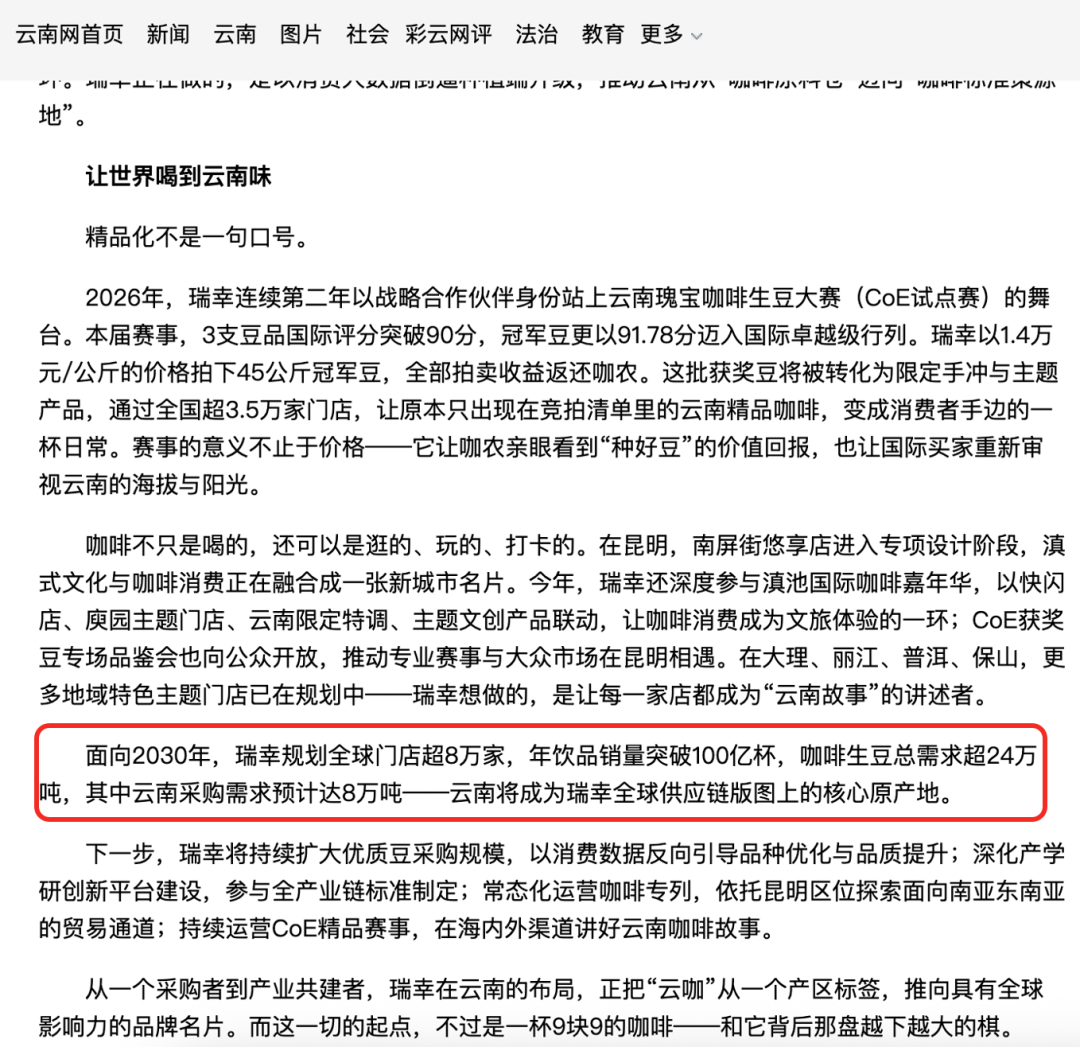
As of 2025, Luckin boasted more than 31,000 global stores. If this plan is formally finalized by the company, it signals an even faster pace of store rollout than its prior target of “replicating 1.5 additional Luckin-scale businesses within five years”. Should the 80,000-store goal be achieved, Luckin will likely overtake Starbucks to become the world’s largest coffee chain.
Let us take a closer look.
An Ambitious Target
In conversations with multiple coffee and tea industry insiders today, all told FoodTalks they had not heard of Luckin’s 80,000-store blueprint and described the figure as quite aggressive. At press time, Luckin had not issued any comments regarding the 80,000-store plan.
What would 80,000+ stores actually mean for Luckin? The chain had 31,048 stores in 2025. To surpass 80,000 outlets by the end of 2030, Luckin would need to add a net average of 9,790 stores per year, equivalent to roughly 27 new net openings every day.
Compared with Luckin’s expansion rhythm in recent years, this target is more aggressive yet not entirely unattainable. From 2023 to 2025, its net annual store additions stood at 8,034, 6,092 and 8,708 respectively. Growth further picked up to 5,262 net new stores in the first half of 2026. If this momentum holds in the second half, Luckin could top 10,000 net new stores for the full year 2026, meeting the growth rate required for the 80,000-store target.
If the 80,000-store target is realized by 2030, Luckin will most likely surpass Starbucks to become the coffee chain with the largest global store footprint.
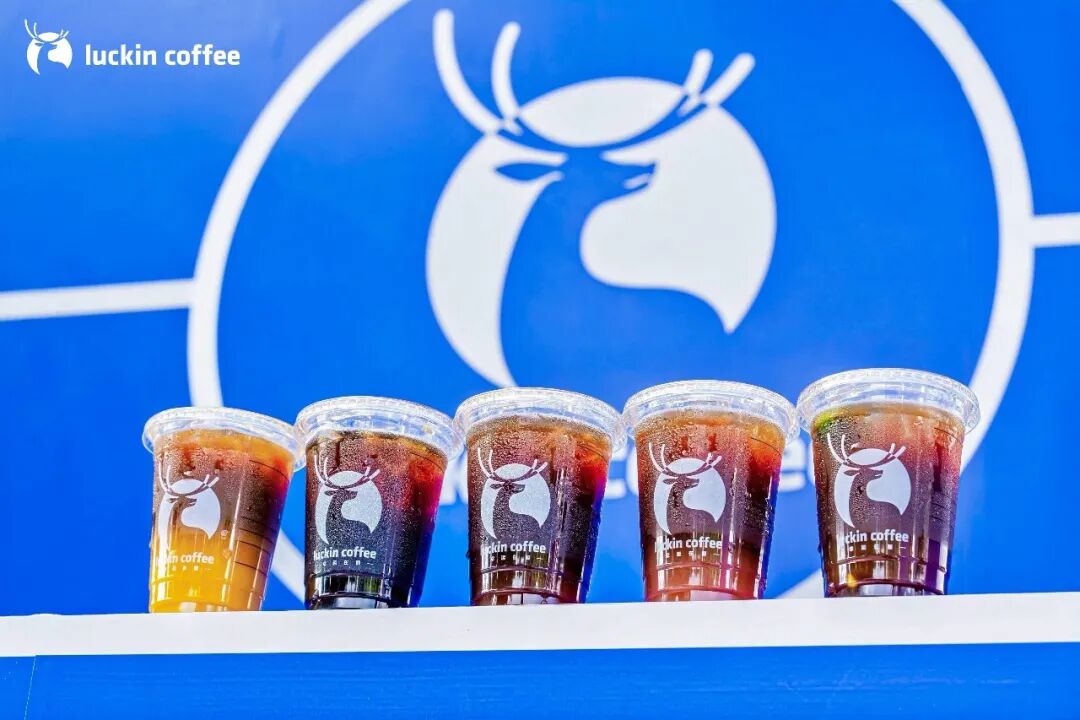
Up to the first half of this year, Starbucks still operated more stores worldwide than Luckin, yet the gap narrowed to around 5,000 outlets, and Starbucks’ current expansion pace is markedly slower. According to financial filings of the two firms: as of June 28, 2026, Starbucks ran 41,304 global stores with a net year-on-year increase of 207. As of June 30, 2026, Luckin had 36,310 global stores, adding 10,104 net new outlets year-on-year.
Back in 2023, Starbucks set a target of 55,000 global stores by 2030. Following leadership reshuffles and strategic adjustments at the coffee giant, it remains unclear whether this goal has been revised. Under its new strategy unveiled in January this year, Starbucks aims to open 5,000 new stores in the U.S., while nearly 40,000 stores will be built outside the U.S. — doubling the overseas footprint, driven by expanding to 15,000–20,000 coffee shops in China.
Nevertheless, these are long-term projections without a definitive timeline for completion. Its confirmed existing targets are a net addition of 600–650 global stores in FY2026 and over 2,000 net new outlets in FY2028, a pace far slower than Luckin’s current rate.
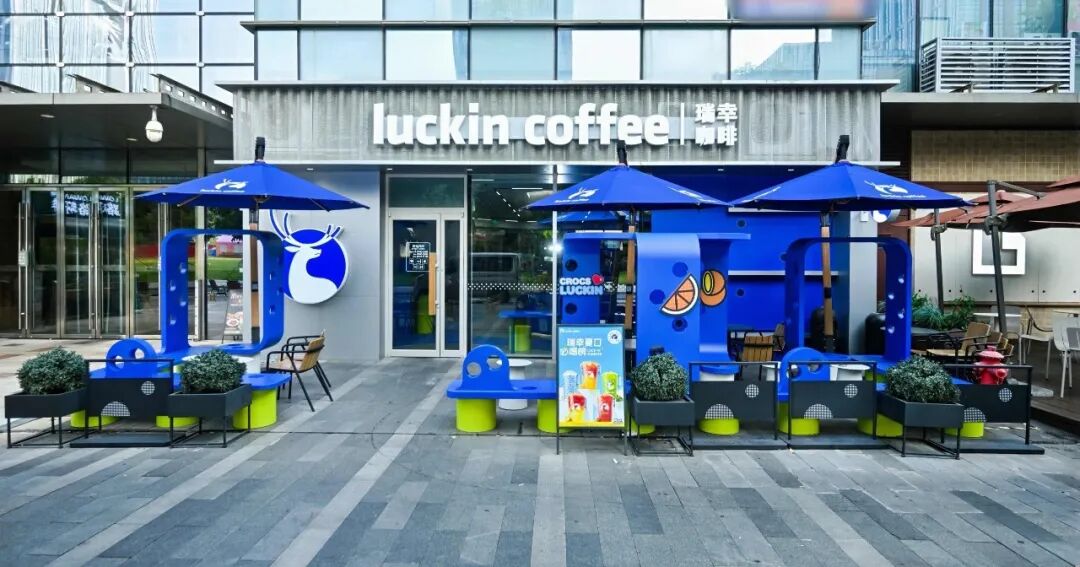
Against the backdrop of convergence between tea and coffee offerings, large chains with 10,000+ outlets including Mixue, Goodme and Hushang Ayi have rolled out or upgraded coffee lines in existing stores to capture sales during breakfast and other time slots, creating stiffer competition for Luckin.
For instance, Mixue Group has ramped up its coffee business this year. Some Mixue Bingcheng stores have installed freshly ground coffee machines, while Lucky Coffee plans to invest hundreds of millions of yuan in brand marketing, mini-programs and apps, and in-store experience upgrades. As of December 31, 2025, Mixue Group operated roughly 60,000 global stores — nearly twice the scale of Luckin — over 90% of which are located in mainland China.
Goodme is racing toward a 20,000-store target by 2027. As of December 31, 2025, it ran 13,554 outlets, more than 12,000 of which are equipped with coffee machines. The brand will focus on developing differentiated coffee products this year. “We hope to shift our track from milk tea to tea-coffee blends,” said Wang Yun’an, Chairman and CEO of Goodme.
This year, Hushang Ayi unveiled its “dual-drive strategy for tea and coffee”. At its 2026 interim results briefing, senior management disclosed that around 9,000 stores have been fitted with upgraded coffee machines. The brand will continue lifting the share of coffee in total cup sales while improving operations via better coffee beans and refined services. Hushang Ayi plans to open 2,000–3,000 new stores this year.
Previously, Chabaidao set a target to roll out coffee offerings across 2,000 stores by the end of 2026. This milestone has already been exceeded in advance, with coverage surpassing 2,700 stores as of June this year.
A Show of Resolve
Faced with fresh competition stemming from tea-coffee integration, Luckin is also fighting back. For example, the brand kicked off a full-category campaign in June this year with the slogan “With Luckin, you have everything”. Its lineup including coffee, fruit tea, light milk tea, vegetable & fruit tea and lemon tea was available at a limited-time starting price of 9.9 yuan.
Beyond product strategy upgrades, store expansion is also viewed as a defensive tool.
For the coffee and tea sector, denser and wider store networks, on the premise of stable same-store sales, do not merely generate incremental revenue. The resulting scale effect also helps boost profit margins. “Without store growth, it is hard to lift business volume and revenue, which is why opening more stores remains a key strategy for many F&B chains,” an F&B management executive commented.
Luckin’s senior executives have repeatedly stated that store expansion is a measure to defend its long-term competitive edge.

“Building out our store network at a competitive pace while maintaining a healthy single-store model is critical to continuously strengthening scale advantages and long-term market layout,” said Guo Jinyi, CEO of Luckin, during the 2026 Q1 earnings call. He added that China’s coffee market is in a period of robust growth with continuously releasing demand and ample long-term upside.
If the 80,000-store plan moves forward, domestic densification and overseas expansion are seen as Luckin’s two core growth pillars.
In a June research note on Luckin, Goldman Sachs argued there remains substantial room for store expansion in mainland China. By the end of 2025, Luckin captured 28% of GMV in mainland China’s freshly ground coffee market — roughly double that of second-placed Starbucks. Using City Café (7-Eleven’s coffee brand, Taiwan’s largest coffee chain), which holds a 35% market share in Taiwan’s freshly ground coffee segment, as a benchmark, Goldman Sachs estimated that matching this market penetration would translate to about 56,000 stores for Luckin, with an upper ceiling of around 69,000 outlets.
Copyright Notice: The content is sourced from online compilations, and the copyright belongs to the original authors. Some articles on this platform are reprinted for non-commercial purposes, shared for discussion and exchange. If there are any objections or infringement concerns, please contact us for removal.