


The coffee market is expanding rapidly. Who is drinking it? And in which scenarios is it the most popular?
07

09
2026
In 2026, the Chinese coffee market will continue to expand.The latest industry data shows that with the advancement of coffee localization and daily use, coffee has evolved from a niche beverage in the past to a mass consumer product covering various scenarios. The market is currently in an accelerated penetration stage. The number of coffee drinkers across the country is expected to exceed 550 million in 2026.
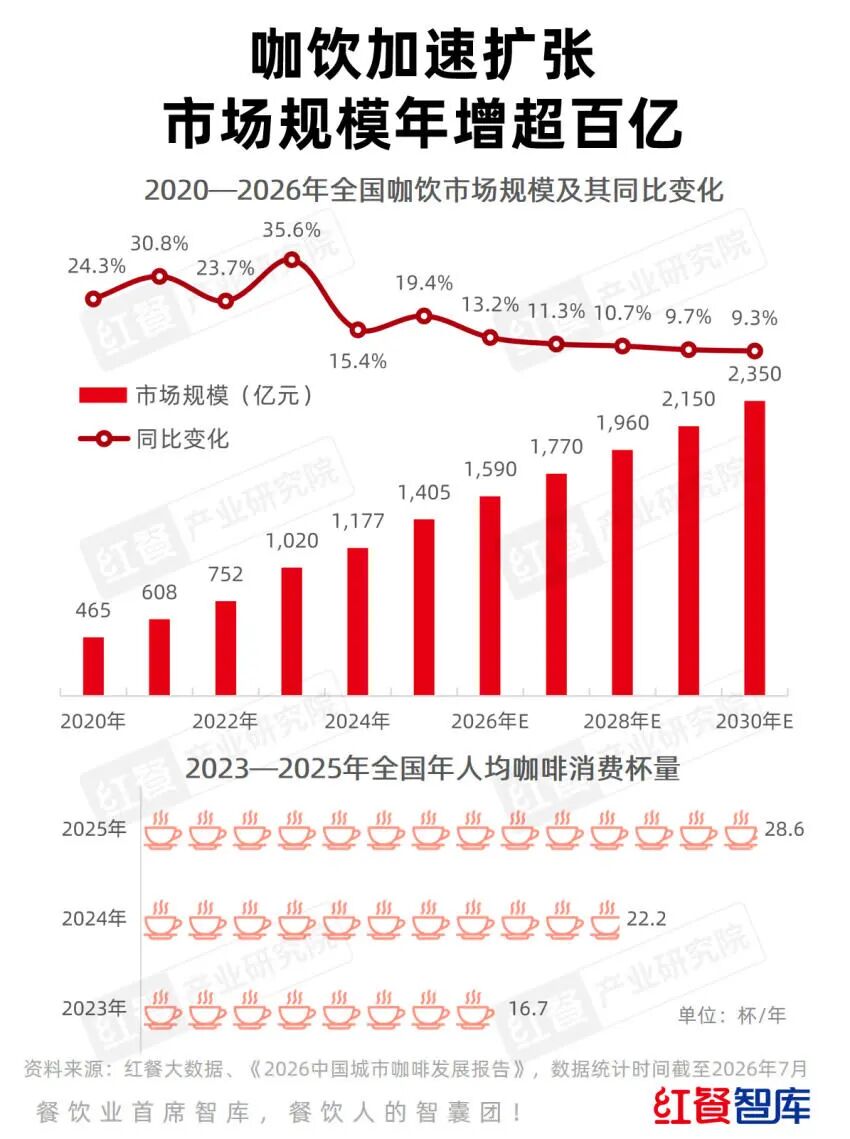
The market size is expected to reach 159 billion, and the per capita consumption of cups has increased to 28.6 cups.
The market size of coffee beverages in China continues to expand. According
to Red Restaurant's big data, the market size of freshly-made coffee beverages will reach 140.5 billion yuan in 2025, with a year-on-year growth rate of 19.4%. It is expected to reach 159 billion yuan in 2026, and the growth rate is expected to remain above 10% for the next three years. This billion-dollar industry will maintain a strong expansion trend.
Driven by sustained growth in consumer demand and market education, consumers' drinking habits have become increasingly stable. The average annual coffee consumption per person rose from 16.7 cups in 2023 to 28.6 cups in 2025—a 1.7-fold increase over two years—indicating that coffee has gradually transitioned from an optional beverage to a frequent necessity.
Population characteristics: Women account for 60%of the total, with young people being the main group.
The consumer base continues to expand, and freshly-made coffee is favored for its superior quality and consumption experience, According to the data from Hongcang Big Data, in 2026, the consumers of freshly-made coffee
across the country will exhibit significant structural characteristics.
Gender structure: Female consumers account for 60.1%,dominating the consumer group.
Age structure: The proportion of people aged 19to 30 is 47.8%,and those aged 31 to 40 account for 33.5%. Together, they make up over 80%, and the young demographic is the core consumer force.
Group type: The consumption group is showing a trend of diversification.Besides the main customer groups such as urban middle class and urban white-collar workers, groups like students and young people from small towns are continuously penetrating at an accelerated pace. Blue-collar workers and the elderly population have also become new growth points.
Consumption behavior: Weekly consumption of one cup becomes the mainstream frequency. Business socializing and daytime work scenarios lead the way.
The trend of making coffee a daily habit is not only reflected in the expansion of the consumer base, but also in the stable consumption frequency and the wide range of consumption scenarios.
Frequency ofconsumption. The proporion of dine-in consumerswho have the habitof dining atleastonce perweek is approximately 65, 9%, the proportion of online food delivery consumers reached
71.0%; the group that orders 2 to 3 times per week also accounted for over 20% (in-person dining 24.7%, online delivery 20.4%), and a stable and frequent consumption habit has been formed.
Consumption scenario: Business socializing (32.7%) and daytime work (30.1%).Among them, the top two were afternoon tea (27.3%) and breakfast pairing (25.2%), followed by study preparation(22.9%), etc. In addition, the proportions of scenarios such as commuting on the way (19.5%), driving to stay alert (15.6%),staying up late for overtime work (12.4%), home relaxation (9.3%), and sports replenishment (7.3%) were also reflected.The coverage of scenarios is becoming increasingly extensive.
The Chinese coffee market is shifting from an expansion based on growth to a focus on deepening the existing market. For industry players, accurately grasping the demands of the core female consumer group and establishing advantages in frequent office and social scenarios will be the key to securing market share.